SK Innovation Tells Shareholders SKIET Merger Was Unavoidable, Promises Return Policy Early Next Year
SK Innovation defended its planned absorption merger with battery separator unit SKIET at a shareholder meeting, citing default risk at the subsidiary, and pledged to unveil a shareholder return policy by early next year.
SK Innovation defended its planned absorption merger with battery separator unit SKIET at a shareholder meeting, citing default risk at the subsidiary, and pledged to unveil a shareholder return policy by early next year.
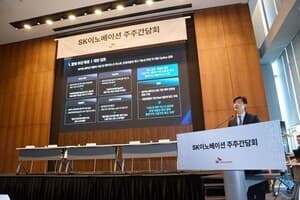
SK Innovation faced pointed questions from shareholders on September 14 as it defended its planned absorption merger with battery separator subsidiary SK IE Technology (SKIET), telling investors gathered at Two IFC in Yeouido, Seoul, that the deal was necessary to prevent a potential default at the subsidiary and to protect the wider SK group from credit-rating fallout.
Seo Geon-gi, head of SK Innovation's finance division, opened the session with an apology for failing to pay a promised dividend of 2,000 won per share after the company posted a net loss of more than 5 trillion won in 2025. He acknowledged that the stock is trading below book value and said management "takes the responsibility seriously."
Shareholders pushed back on the merger terms, noting that up to 2.6% new-share dilution would result from the deal while other listed companies have been retiring treasury shares to reward investors. One shareholder said SK Innovation's share count would actually increase through the merger even as peers shrink theirs, and criticized the absence of a concrete near-term return plan. In response, Bae Gi-rak, head of the finance planning office, said internal discussions on dividends and share buybacks are underway and promised a detailed shareholder return policy "by the end of this year at the latest, or early next year."
On the necessity of the merger itself, executives said SKIET's ability to generate cash has been squeezed by delayed U.S. EV subsidy-driven demand recovery and aggressive capacity expansion and price competition from Chinese rivals. Keeping SKIET as an independent listed entity, they argued, would raise the risk of loan default as losses accumulate, potentially dragging down credit ratings across the SK group. A third-party sale was also ruled out as unrealistic given weak buyer interest in listed separator makers.
Management framed the deal as more than absorbing a struggling unit, describing it as part of a broader effort to streamline operations against Chinese competition in the battery value chain. Officials pointed to savings from eliminating duplicate listing costs, marketing expenses and brand fees, along with reduced interest costs stemming from the two companies' differing credit profiles. Kim Yoon-hye, head of the strategy office, added that supplying separators directly to battery affiliate SK On could open up new order opportunities, particularly in the energy storage system (ESS) market, which the company is positioning as a near-term offset to the prolonged slump in electric vehicle demand.
On the key risk to closing the deal — shareholders exercising appraisal rights — Bae said the company has set a cap of 350 billion won but will proceed with the merger even if that threshold is exceeded, by revising the board-approved merger terms if necessary. He expressed confidence that cash on hand and short-term borrowing would cover any overflow, and noted that a related 300 billion won price-return-swap contract tied to SKIET is likely to be settled through the appraisal-rights process.
Related companies
Where it matters
Related coverage
Naver to Invest in Gurin Solar Project in South Korea
Naver is set to invest in and purchase power from Gurin Energy's solar project.
Yuanta Lifts SK Innovation Target Price to 200,000 Won, Sees 10 Trillion Won Operating Profit
Samsung Heavy Industries Shares Jump on $1.2 Billion Vessel Order and Gastech 2026 Push
Samsung Heavy Industries shares climbed after the shipbuilder secured a $1.2 billion order for six large vessels and showcased its FLNG technology at Gastech 2026 in Bangkok.